
Co-authored by Valerie Ehrlich and Rachel Kimber.
TL;DR: Your organization’s AI policy isn't just a document — it's a living practice (or, it should be!). We're sharing three layers of policy and practice that help nonprofits build AI governance that evolves with technology while staying true to their values. Plus, we'll share ideas for how to avoid the most common pitfalls and create psychological safety for experimentation. This piece stems from a recent presentation we gave at the Center for Digital Strategy’s AI for Nonprofits & Advocacy Summit.
The pace of policy development in nonprofits is lagging far behind the pace of interest in the use and potential of generative AI tools, and that’s a big problem. For a sector focused on mission-driven work, filled with employees and stakeholders who want to ensure these tools are leveraged for good and in line with their ethics, the lack of guardrails is a gap that we need to work quickly to close. As this recent survey by TechSoup shows, many nonprofits, especially smaller ones, don’t yet have a policy in place.
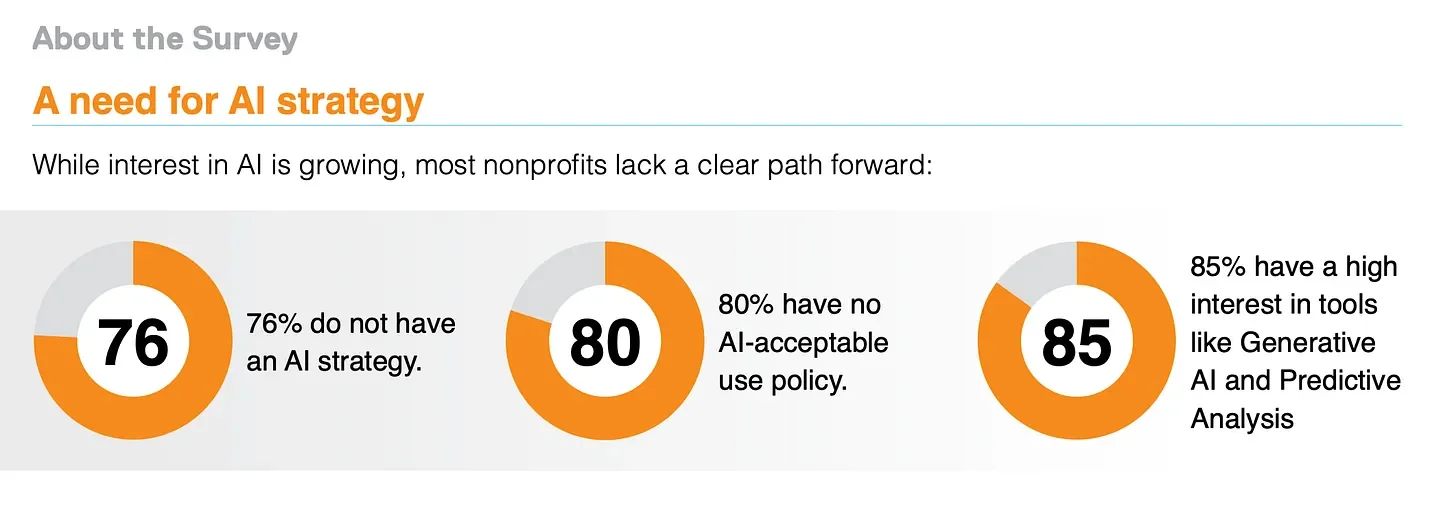
Data from TechSoup and TAPP Network. You can download the full report here.
And, we get it. “Policy” is a daunting word. It feels final, legal, and high stakes. But exploring generative AI without it is too risky. And, given the amount of shadow AI use happening in organizations, you can be certain your employees would benefit from knowing what is on and off the table when it comes to AI.
So, we want to offer a different lens for AI policy development.
What if AI policy development could be your organization's most collaborative, engaging, and human-centered process? What if, instead of another compliance exercise, it became a catalyst for bringing people together around shared values and possibilities? These are the questions we asked recently in our presentation with the Center for Digital Strategy. You can view our slides here.

What would it look like for policy to allow for collective movement balanced with individual practice? Photo by Rhys Kentish on Unsplash
Right now, so many organizations are approaching AI with a limiting approach, sometimes going so far as to ban the use of any AI tools outright. We argue that banning a tool that is so widely accessible, transformative for day-to-day tasks, and yes, potentially very disruptive, doesn’t set mission-driven organizations up for success. Others are working on policies, but taking a long time to do it. What is happening with their data in the interim? What is happening to the learning that might be occurring informally amongst their staff?
AI is not business as usual, so our approach to designing, defining, and revising policies needs to adapt as a result.
AI is giving us a rare opportunity to completely reimagine how we create organizational policies. Unlike traditional policies that often emerge from legal requirements or risk management, AI policy invites us to start with the humans — their creativity, their concerns, their experiments, and their wisdom. Legal, tech, and risk management considerations have to be present, but they need to be in collaboration with users across the organization.
We came to this realization through decades of working with nonprofits on very different paths. We’ve seen organizational cultures that have the psychological safety to support experimentation with AI, policies that offer guardrails and guidance, and, at the same time, organizations that stall or freeze, trying to first create the ‘perfect’ policy or doing months of internal self-study before developing a policy that is destined to be quickly outdated. In our experience, we’ve seen that the key is a balance between structure and flexibility, and designing your policy creation to accommodate both.

Image by Christoph Meinersmann from Pixabay
Focus on Cultivating the Garden, Not Carving in Stone
Let's start with a metaphor that informs how we think about AI governance. Traditional policies are like monuments — impressive, solid, (probably) unchanging. But AI policy needs to be like a garden:
The master plan (Capital "P" Policy): Your perennial values and principles. This could be stone, but is probably more like a temporary art exhibit in the garden. It’s sturdy enough to weather the elements, but its time is limited.
The planting calendar (lowercase "p" policies): Seasonal guidance for specific tools and teams.
Weekly weeding and watering (practice): Daily experiments and learning.
After analyzing what separates organizations that thrive with AI from those that struggle, we've identified how these three essential layers function together.
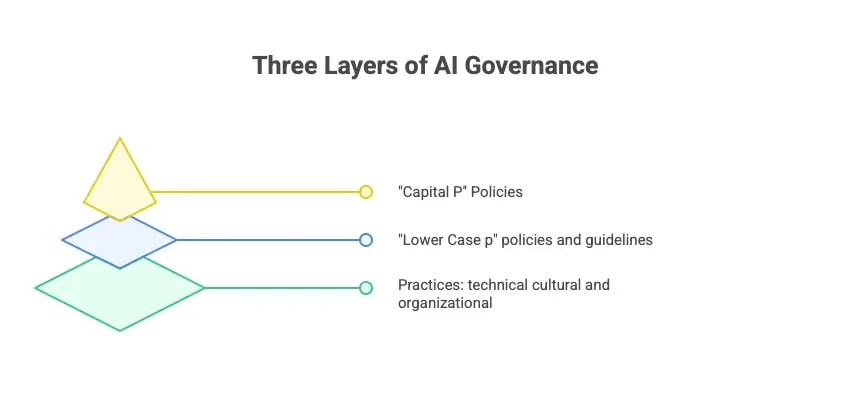
Three Layers of AI Governance: Made with Napkin.AI
Capital "P" Policy
What it is: Strategic, values-based principles that rarely change. These are your evergreen principles and values. You can likely draw inspiration for these from your existing policies and mission/vision statements. Thinking about how you want to handle employee agency and autonomy, how you’ll treat participant/client data, transparency that you want to have with your stakeholders, and your regular cadence of feedback, review, and revision are all elements of your “capital P policy work.”
If you’ve done values work as an organization, this is the place to bring it in. What are your core values, and what do you hold true in order to achieve your mission? What policy (or policies) do you need to put in place to ensure those values are maintained?
Examples of underlying questions:
“How do our values guide our use of AI?”
“How will we be transparent about AI use with our stakeholders?”
“How will we protect beneficiary privacy in all AI applications?”
“When and how will we regularly audit AI tools for bias?”
Examples of Policy types:
AI Ethics Charter: A statement of the organization's commitment to responsible AI development and use, grounded in values and mission.
Data Privacy Principles: Guidelines for the collection, storage, and use of data in AI systems, ensuring compliance with relevant regulations.
Algorithmic Bias Mitigation Policy: A commitment to identifying and mitigating bias in AI algorithms.
Human Oversight Policy: Requirements for human involvement in critical AI decision-making processes.
Review cycle: Annually
Lowercase "p" policies
What it is: Department or tool-specific guidelines. These are your practice guidelines that help people understand how to get actionable and actually use the tools in a way that build on their role and expertise while staying within the Policy guidelines. This is where the policy begins to come to life in that people can see how it relates to their role while also seeing what it enables them to do.
Examples:
"Marketing can use approved AI tools for first drafts, but humans review all public content"
"Grant writers must disclose AI assistance in proposals"
"Development cannot use AI for donor research without consent protocols"
Review cycle: Quarterly
AI Workplace Ethics & Wellness
Governance doesn’t have to be the enemy of innovation (Paul Chaney, linked above), and practice guidelines are the place where innovation and experimentation can be supported with the overarching policy in mind.
Keeping these up-to-date, relevant, and accessible will be critical to their success. While the Policy conveys the evergreen values and non-negotiables with your AI use, these policy guidelines will need to be revisited more regularly to keep up with the pace of advances in technology. Each department likely has an existing process of reviewing their practice guidelines and protocols for other tasks (e.g., data retention policies for evaluation, donor information updates for development), and the policy guideline work can build from that.
Practice
What it is: The daily experiments, pilots, and learning. This is the fodder and where your AI practice in your organization will grow. The key with practice is the scaffolding that surrounds it (to keep with the metaphor, think of the strings and cages that support tomatoes and peas as they grow). Creating places where people can experiment, practice, document learnings, and share their experiences supports effective practice.
A bonus of well-shared experimentation stories is that they can reinforce your policy and practice guidelines and identify the revisions needed for the next iteration. When colleagues begin to see what is possible with AI within the parameters you’ve set, it can spark ideas for them. Likewise, when you see what might be possible with an adjustment to your policies or practices, you can better weigh the possible costs and benefits when choosing to revise your policy (or not).
Examples:
Testing approved tools for meeting summaries
Piloting AI transcription for community listening sessions (and gathering feedback about the experience)
Experimenting with AI for volunteer scheduling
Review cycle: Ongoing
Tending the Garden
The magic happens when these three layers inform each other bidirectionally. Practice generates insights that shape guidelines, which eventually influence Policy. It's iterative, messy, and exactly what works.
During our presentation, we shared how one evaluation team's experiments with AI floated questions up to the policy level that nobody had anticipated. "What about this use case? What about this type of data?" Their practice exposed gaps in policy categories that hadn’t been considered. This is the beauty of the three-layer system — it's self-correcting. Your practice becomes your policy radar, detecting issues before they become problems.
ED-Ps: Your Policy Compass
Rachel has a handy way of remembering the core principles that should guide your decision-making. This can undergird your policy discussions as well as serve as a guide when you don’t have an organizational policy to rely on to guide your AI use. EDPs stands for: Ethics, Data, Privacy & Security. As Rachel shared during our session, this simple acronym becomes your decision-making compass for every AI interaction.
Start with Ethics. If a tool doesn't align with your personal or organizational ethics, stop right there. If you aren’t sure, try to get clarity so that you can weigh the costs and benefits based on your core values and ethics.
Next comes Data. Whose data is it? If it's your personal resume, go ahead and pop it into AI for that bio rewrite. But organizational data? That's when you need to identify the data owner and get explicit permission. "Can I use this donor list?" might become "Sure, but remove columns A, B, and C first."
Privacy and Security round out your check. Are you protecting stakeholder information? Is the tool you're using secure enough for the data you're handling?
EDPs isn't just a checklist; it's your guardrail when everything else feels uncertain. Write it on a sticky note. Make it your screensaver. Because until your organization has formal policies, EDPs keeps you ethically grounded and legally safer (though we aren’t giving legal advice because that’s not our lane!).
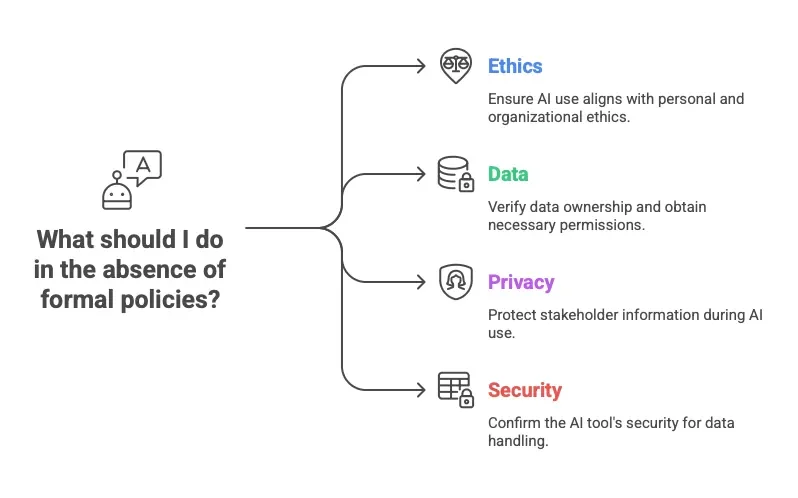
Keep these four things in mind when using AI: ethics, data, privacy, and security. Made with Napkin.AI
Four Pitfalls That Can Kill AI Policies Before They Start
We’ve shared what we think helps AI policy development be the most optimal. But what about the pitfalls to look out for? Here are some things we’ve seen:
The Lockdown
What it looks like: "All AI tools are prohibited."
Why it fails: Your best people will find workarounds. You'll lose both innovation and the ability to guide it. You’ll lose awareness of what people are doing with these tools. Shadow AI use is a real thing and puts your organization and data at risk. But it’s also unrealistic. Even your day-to-day tools are beginning to natively insert AI into their workflows. Recent research suggests that nearly 2/3 of Americans don’t realize they are using AI through embedded tools. Without guidance, those integrations introduce risk that you want to educate people on how to understand.
The Copy-Paste Special
What it looks like: A policy written for another organization. Lindsey Fuller and Marisol Pineda Conde of the Teaching Well have a wonderful podcast episode on Human-Centered Policies that is absolutely worth checking out. They call out the temptation to copy and paste policies because of the challenges this can produce. When creating a policy from scratch feels daunting, it seems nice to borrow from someone who's done it before.
Why it fails: Your context is unique. That university's policy won't work for your grassroots advocacy org. Understanding the big buckets that peer organizations are covering in their policies is certainly useful, but that information needs to serve as the backdrop for the collaborative creation you’ll do in the foreground. And, a template shouldn’t replace the in-person dialogue that should guide your policy. That dialogue is necessary to build buy-in and create a policy that resonates with your staff. Templates can get the ball rolling, but you’ll want to guide where it ends up.
The PhD Thesis
What it looks like: "Large language models utilizing transformer architecture with attention mechanisms..."
Why it fails: If your program staff can't understand it, they can't follow it. Policies that are overwhelming and filled with jargon are destined to be ignored. This is also why practice guidelines are so important. They can help turn policy language and the sections that might need to be more opaque into clearer guidelines. They can also be adapted to go deeper or more technical where needed, and keep to a higher level for other departments, depending on their needs.
The Desert Island Policy
What it looks like: A beautiful PDF on the shared drive with no training, no FAQ, no support.
Why it fails: Policies without implementation support are just wishful thinking. Policies that aren’t connected to practice will be ignored.
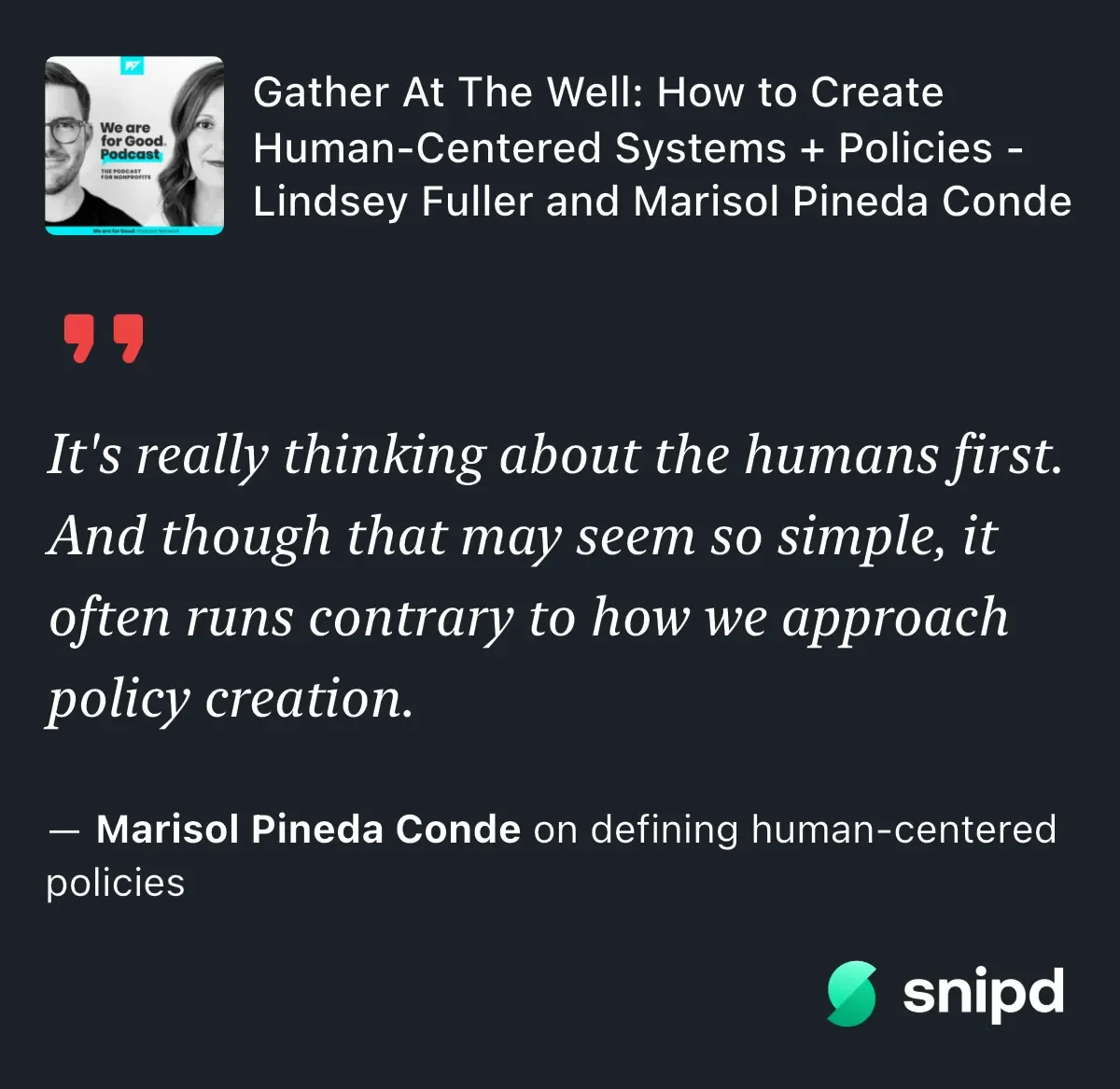
Be sure to check out the entire episode of Gather at the Well, a series from the We Are for Good Podcast.
Building Psychological Safety (Or: How to Not Terrify Your Team)
Policies are developed and adhered to in the context of broader organizational culture. So, any discussion of policy needs to consider how the culture will influence the success of that policy, its application, and how it actually ends up influencing practice.
Thus, here's a core issue we need to be talking about: fear kills AI adoption faster than any bad policy. And fear of AI is multi-faceted. Mission-driven professionals are simultaneously wanting to engage these tools correctly, not put their organizations at risk, while also feeling fear and concern around what these tools will mean for themselves, their communities, and our planet. We’ve learned this through our work implementing grant management systems and evaluation systems — the technology was never the hard part. Creating safety for experimentation was.
Psychological safety can support innovation and experimentation by creating the conditions to share learnings, failures, and seek assistance on challenges. But, it has to be created and maintained in collaboration (i.e., generally, you can’t tell people they have psychological safety, it’s something they need to feel and experience).
Here are some ways to engage in AI practice and buid psychological safety at the same time:
Create sandbox spaces: Designate Friday afternoons as "AI exploration time." No deliverables, just learning. Bring people together to share and reflect. If you can’t make time for it as a standing meeting, create a shared space on Teams or Slack where people can share what they are learning.
Celebrate productive failures: Make it standard practice to include the “AI fails” — there will be plenty, trust us! These help keep us grounded when we see what AI is able to do and what it’s not able to do. It also helps build our eye for critique and our muscle for spotting the errors within AI.
Protect your pioneers: Give them space to experiment, share their failures, and speak their names into meetings related to strategy and innovation. They are thinking outside the box, and you’ll want strong and honest communication practices that support their ability to experiment, reflect, share what they are learning, and influence the future use of AI at your organization.
Without psychological safety, your policies become theater. People pretend to comply while secretly experimenting without support or documentation.
Making It Real: Your Evaluation Framework
Given Valerie’s evaluation background, we’d be remiss if we didn’t discuss how to identify, understand, and track implementation of your layers of policy, because what gets measured gets attention. But measurement itself must be adaptive, and that’s even more true with AI. Here are some ideas for how to keep tabs on your progress while collecting information that will be useful in your review cycles.
For Capital "P" Policy
Measure: Values alignment, leadership confidence, employee understanding
How: Annual pulse surveys, stakeholder interviews
Key question: "Are we still who we say we are?" “Does this policy support our mission, vision, and values?”
For lowercase "p" policies
Measure: Adoption rates, iteration frequency, cross-department learning
How: Quarterly reviews, usage analytics
Key question: "What's working that we can scale?" “What tools are people using and not using, and what does this tell us about our support?”
For practice
Measure: Experiments started, lessons documented, peer teaching moments
How: Monthly check-ins, experiment logs
Key question: "What are we learning?" “What do we wish we could do that we can’t do yet?”
There are different rhythms for different layers and goals. Your practice metrics are your leading indicators — they tell you what's coming and what you might be overlooking at higher levels. Your Policy metrics are lagging indicators — they confirm cultural shift.
The Resource Costs
As we noted in our presentation, the question isn't whether to invest time in AI governance (we should all be doing that starting yesterday), but whether that time will be coordinated and productive or scattered and risky. And, ultimately, will your investment be a process that contributes toward the adaptive organizational cultures you want to build? Nonprofits have always been low on resources, and these days it’s no different.
Here's what we think it takes in terms of time, personnel, and cost:
Time: Start with 2-4 hours monthly as a group; 1-2 hours a week as a team; and 15 minutes a day as an individual (or 11 minutes, as Microsoft argues). As you build momentum, it becomes part of how you work, not extra work.
People: You need experimenters (they're already using AI), translators (they can explain it), and documenters (they capture the learning). Importantly, you’ll want to look beyond job titles and organizational hierarchy to find these folks. Go where the energy is.
Money: Start with low-cost* tools and small pilots. Budget your resources (especially time) for learning, not just licenses. Don’t assume you’ll find one tool that will work for everything, so consider how you might use a few tools together.
Multipliers: Partner with peer organizations. Join learning cohorts. Document everything so you don't duplicate effort. We’re all learning as we go, and these spaces can provide valuable thought partners.
*It’s tempting to go for free versions of software. That can work, but be mindful of the information you’re putting into it. If it’s free, you’re the product.
Your Micro-Moves for This Week
One goal of this Substack is to take the ideas and make them actionable. Even if you aren’t in the room where the policy is being created, everyone can influence and inform policy.
Map one AI use in your organization across all three layers. Where are the gaps? Where do you see the layers of Policy, policy, and practice, and which ones are missing?
Start an experiment log. Use Airtable, a shared Google or Teams doc. What did you try? What happened? What worked, what didn’t? What did you learn?
Have coffee with someone in your organization who's wrestling with AI. Listen for their values and fears and share yours as well. What can you learn from one another? What guidelines would be helpful? How can you commit to keeping values at the center?
Tending the Garden Together
AI policy can’t be solely about control. It has to be as much about the culture that surrounds it. We can focus on what is prohibited, but we need the language, support, structures, and resources to also focus on what is possible. And, while we want policies that are iron-clad and perfect, it’s probably unreasonable to expect that, especially with AI.
Just as no garden thrives in isolation, your AI practice needs cross-pollination. During our sessions and others that we facilitate, we see it happen time and again — someone shares an idea or a way they used a new tool and what happened, another person asks questions that help clarify learnings, and still others use the idea as a spark for something they want to try.
This is how gardens grow: through shared cuttings, borrowed seeds, and comparing notes on what survived the frost. When done in a human-centered, adaptable way, creating your AI policy can move beyond static documentation to leverage the collective wisdom of every experiment, every failure, and every small victory with AI across your organization.
Some days you'll be planting new ideas. Other days, you'll be pulling weeds (those risky shadow AI practices). Sometimes you'll need to prune back overgrowth (sunset those outdated policies). But mostly, you'll be doing what gardeners do best: paying attention, adjusting to conditions, and sharing what you learn with your neighbors.
Start small. Plant one seed. Document what grows. Share your harvest.
You're writing your organization’s AI future right now, one experiment at a time, one reflection at a time, and one brave conversation at a time. Your policy is a really important piece of that, and it’s worth the investment.
AI Collaboration Note
In the spirit of transparency we advocate for in this post, here's how we used AI in creating it: We began by transforming our presentation slides and speaker notes into an initial draft outline using Claude. We then revisited the draft after we delivered the presentation and provided the presentation transcript (generated with Granola.ai) to leverage our verbal delivery of the content for this piece. That gave us a more thorough draft we could volley back and forth. Throughout the writing process, we used AI as a thought partner to help identify key themes from our presentation transcript, refine our examples, and ensure our three-layer framework was clearly explained (and think of better headings). We maintained full editorial control, adding our own experiences and significantly revising the AI-generated content to match our voice and reflect our insights. The final piece represents our authentic expertise, with AI serving as a collaborative tool, much like the human-centered AI adoption we're encouraging you to explore. All statistics, examples, and recommendations come from our direct experience working with nonprofits and resources we’ve collected over time.
Valerie Ehrlich is the founder of Mission Bloom Consulting, where she helps nonprofits and foundations build their AI capacity while building learning cultures that embrace change. Rachel Kimber leads Full Circle Impact Solutions, focusing on human-centered technology implementation. They met through SheLeadsAI and bonded over their shared frustration with static approaches to dynamic challenges.
Want more? Check out Valerie's newsletter The Bloom Shift and Rachel's writing on AI in philanthropy.

Valerie Ehrlich, PhD, is the principal of Mission Bloom, where she helps mission-driven leaders use AI responsibly, smartly, and powerfully. She specializes in helping organizations in the social sector navigate AI implementation from a values-centered perspective.