
Your AI Word of the Year: Setting Intentions Over Goals for 2026
A practical guide to choosing and using a guiding word for AI engagement
In 2025, everyone had AI opinions. As I’ve written about previously (here and here), the discourse around AI is divisive and doesn’t leave room for questioning and uncertainty. Some headlines insisted you’d be left behind if you didn’t adopt everything immediately. Others warned you’d lose your soul if you touched it at all.
I am becoming increasingly worried about the polarization and politicization around AI, seeing more and more progressive, mission-minded folks refuse to use the tool and more of my colleagues who do use it afraid to talk about their use, especially in personal/social settings. At such a critical inflection point (Tristan Harris says we have two years to figure this out), we need all hands on deck, and especially mission-driven hands.
So, in 2026, I’m asking you to do something different: set an AI intention instead.
Maybe you’re an avid AI experimenter and you want to make sure you maintain your humanity amidst your use; maybe you’re an outright resister but you have to use it for work or you’re a tiny bit curious if there’s a way to use it at all that meshes with your values. You might not have even considered an AI related resolution, but I hope you’ll consider an AI intention.

Yutong Liu & Digit / https://betterimagesofai.org / https://creativecommons.org/licenses/by/4.0/
The Problem with (AI) Resolutions
New Year’s resolutions often falter because they set us up to think from a deficit perspective: what we’re not doing, what we should be doing, what everyone else is doing that we wish we could do. Applying this logic to AI would be even worse, but it is often what is happening across the discourse or within organizations as they seek to roll out an “AI strategy”. We feel either pushed toward frantic adoption (learn ChatGPT! Master prompts! Automate everything! Agents!) or complete avoidance (AI is unethical! It’ll steal jobs! It’s going to destroy the earth/human race! I’m staying human!).
Resolutions miss the space in between. The space between awareness and adoption, skepticism and curiosity. The place where most of us actually live and work across the complex layers of our daily lives. The place where we actually make our decisions.
In terms of AI, this in-between space is where we can be guided by intention and stay connected to our values. Where we can use AI cautiously and curiously while maintaining serious concerns about its implications. Where we can ask better questions than “Should I use AI?” and instead ask “How do I want to show up as I navigate AI?”
Why a Word Instead of Goals
For years, I’ve practiced choosing a word (or two) to guide my year. Not goals (I gave up on those years ago — they just don’t work for my brain!) or “KPIs”. Just a simple intention I can return to when things feel overwhelming or unclear. I literally write them on a sticky note and stick it to my monitor to help me remember. It’s less about the “thing(s)” I want to do or accomplish, but more about the energy I want to bring to each choice as I navigate my year.
I began this practice after reading Melinda Gates’s reflection on the power of a single guiding word, and it aligned perfectly with what I know to be true about human development and transformation: to make something stick, it needs to be simple and directly relevant. It needs to become a mindset that guides behaviors and decisions (a la Atomic Habits).
My past words have included “bravely curious” (2019), “grace & care” (2021), “perspective & energy” (2022), “invitation & courage” (2023), “cultivate & resonance” (2024), and “abundance & practice” (2025). Each one helped me navigate professional transitions, balance motherhood and leadership, manage energy during exhausting times, and see challenges as invitations rather than obstacles. They offered me things throughout the year that I either wanted to intentionally grow within myself or things that I sensed would be important to always keep in mind.
For 2025, my words were “abundance” and “practice.” As I built my consulting practice focused on helping mission-driven leaders use AI responsibly, these words kept me grounded. Abundance helped me deal with the day-to-day grind of solopreneurship with a healthier mindset instead of focusing on scarcity and therefore committing to projects that weren’t in alignment with my overall goals. Practice connected to the small shifts of daily habits and the ability to focus on progress over perfection. This list by Morgan Harper Nichols forever inspires my broader intention setting (her art is beautiful and I love to print the picture that goes along with my chosen word!)
This year, as I’ve watched leaders in the social sector wrestle with AI adoption, I’ve realized how much they need this practice too. And while it’s a practice I’ve always advised in my coaching and leadership work, I began to think that we really need this practice as it relates to AI. When we’re feeling overwhelmed and unsure where to go, intention (and values) can be a guiding force.
Wrestling with AI in Your Own Practice
What I’ve learned from my own AI journey this past year is that there is no clear rulebook for “good” AI use. Your context, your values, your mission are all unique to you and different from mine. My work has been about helping people identify their context and helping them use that to guide their experimentation and implementation with AI. So, what I can offer is a framework for staying intentional as you figure out what AI use looks like to you (versus what the headlines say you should be doing).
These intention words are designed to keep you grounded as you navigate the overwhelming speed and disruption that AI is bringing to all domains of our lives. They help you ask: Does this AI choice I’m making resonate with my mission/vision/values/goals? Am I cultivating something sustainable here, or just reacting to hype?
Those questions can help you navigate countless decisions, from the mundane to the existential:
When to use AI for meeting notes versus when the act of note-taking itself mattered
How to talk about AI with clients who feel differently about AI than you do
Which AI tools aligned with your values and which don’t
The word keeps your ‘work at the center’, to borrow language from emergent learning practices. Instead of letting the AI noise obscure what actually matters, an intention word can help you stay focused on the change you want to create in the world and where AI might be of service.
Choosing Your Relationship with AI
Instead of another flashy infographic or flow-chart decision-making tree, I’ve created for you a list of 60-ish intention words specifically for AI navigation. These are intended to help you define your relationship with this technology in a way that feels true to who you are and what you care about.
These terms are invitations to approach AI from different stances; I’ve categorized them across different areas of emphasis. Some call you toward action and implementation, while others remind you to lead with wisdom and discernment. The idea is to flip through and see what word grabs you. It might click for you in a way that feels like exactly what you’ve been missing, or it might unsettle you or excite you. That’s how you’ll know it sticks (and the sticky note trick, too!).
Each word comes with a definition specific to AI use and a guiding question to help you anchor the intention in your day-to-day decisions. Those definitions and questions are just starting points. Edit as you wish to make it resonate with you.
For example:
DISCERN
Definition: Distinguishing meaningful AI use from distraction
Question: Does this AI choice serve my mission or just my convenience?
STEWARD
Definition: Using AI as a responsible caretaker of your mission and community
Question: How does this AI choice honor what I’ve been entrusted with?
WONDER
Definition: Approaching AI with awe and inquiry rather than fear or hype
Question: What does this AI capability reveal about how I think and work and what might be possible?
You might find that multiple words call to you. That's okay! I often choose two and enjoy exploring how they work together. You can also play with the form by adding '-ing' to make it feel more active (like "cultivating" or "tending"), or shifting it to a noun (like "creation" or "reflection"). Choose whatever form speaks to you most.
Intention Words for 2026
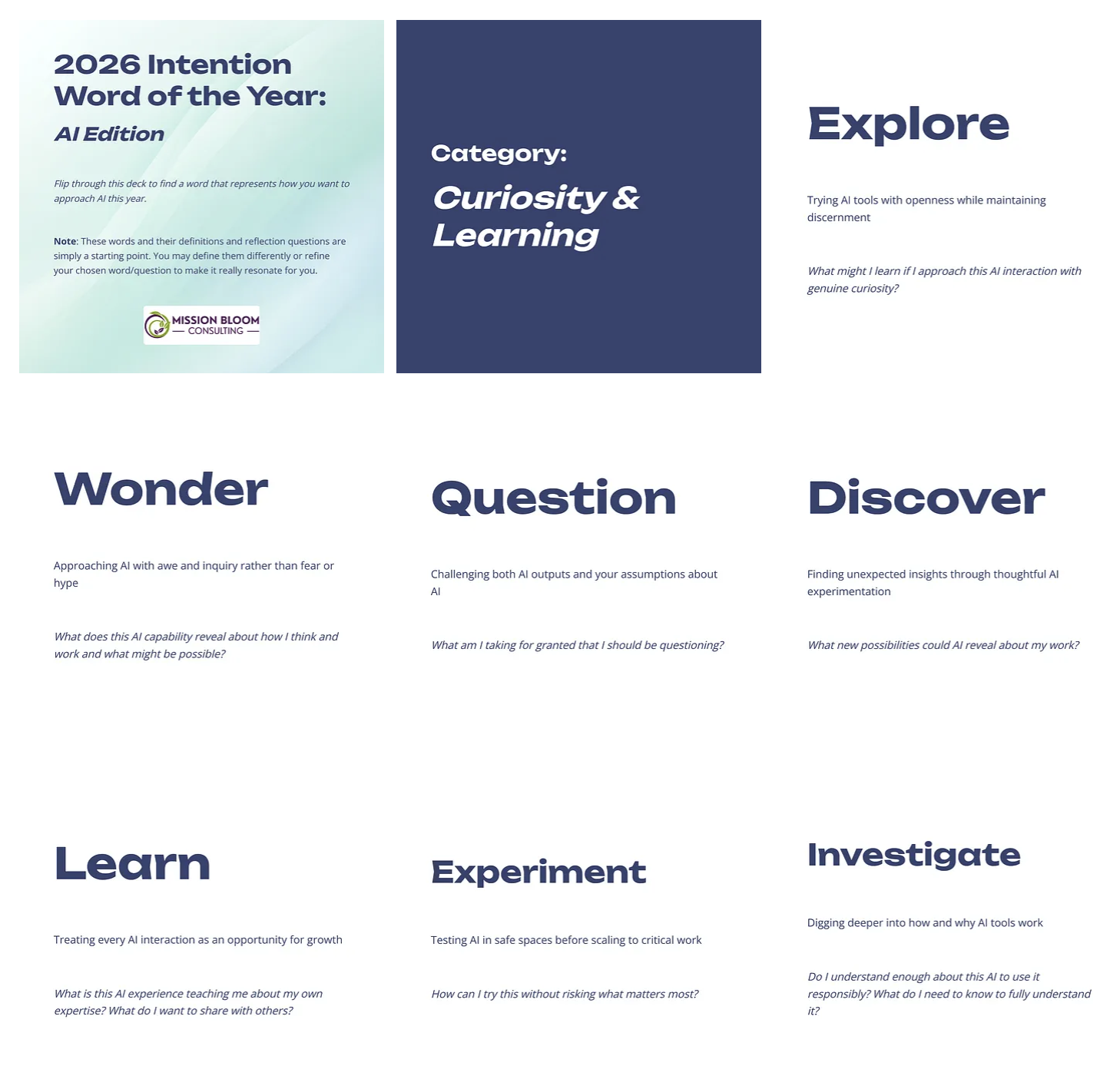
View the entire list here: https://gamma.app/docs/2026-Intention-Word-of-the-Year--aa9m4esr93k1vhk
Choosing your word is only the first step!
Once you’ve chosen your word, the real work begins: keeping it at the center of your work. Here are practices adapted from one of my favorite methods (emergent learning) that can help:
Ask yourself: What will it take to do this?
If your word is “selective,” what will it take to actually be selective with AI? What conditions, knowledge, or support do you need? If your word is “integrate,” what will it take to weave AI into your workflows without losing what makes your work human?
Think about the if/thens
If you can hold your intention, what will it open up for you? Examples: If I can focus on being “mindful” with AI, then I will use it consciously rather than on autopilot. If I can approach AI with “wonder,” then I might discover insights about my own thinking I wouldn’t have otherwise noticed.
Conduct regular reflections
This is challenging, but taking a few minutes each month to reflect on your word can be transformative. The sticky note on the monitor helps with this by keeping it front of mind. Ask yourself: How have I remembered my intention this month? When did I leverage it in a challenging moment? What has it taught me? This is essentially a before/after action review with yourself about your AI relationship.
Create shared accountability
If there’s one thing I’ve learned about learning, it’s that shared practices in groups can be powerful. Ask your colleagues, your team, or your network to try this practice with you. Commit to bringing up your AI intention and exploring it together. The beauty of a word-of-the-year is that it’s a “no fail” experiment. Whatever insight you draw from it will be valuable!
The Third Space Is Where Real Work Happens
A single word or intention won’t solve the complexity of AI adoption. Our task isn’t to solve the biggest problems, but to figure out what we can do in our own behaviors to create ripples toward how we want the future to be, collectively.
An intention won’t answer every ethical question or eliminate every tension. But it can give you something to hold onto when the AI discourse feels overwhelming, when you’re not sure if you’re doing it “right,” when you’re caught between pressure to adopt and the very real and valid fear of harm.
This in-between is where most meaningful work happens. It’s where you can be honest about AI’s potential and its problems. Where you can use it thoughtfully while staying critical. Where you can experiment while protecting what matters.
Your intention word is your compass in that space. It won’t tell you exactly where to go, but it will help you know if you’re moving in a direction that feels true.
Your Turn
As we head into 2026, I encourage you to carve out some reflection time to discover what word captures your hopes for how you want to show up as you navigate AI in the year ahead.
Tips for Choosing & Using Your AI Intention Word:
Reflect on your AI use this past year: What felt aligned with your values? What felt forced or reactive?
Imagine your best possible relationship with AI: What qualities or values matter most?
Review the ~60 words and notice which ones grab you and won’t let go
Brainstorm words that address your specific AI feelings. There are many you could focus on, but what feels most useful now?
Test drive your top choices: Do they inspire you? Challenge you? Resonate with something deeper?
Display the word prominently (sticky note, phone wallpaper, visual card)
Share your word with colleagues or friends for mutual support and accountability
Periodically review how your word has shaped your AI decisions
Revisit your word during AI challenges as a guiding reminder
At year’s end, reflect on how your word shaped your AI journey
I’ll be sharing the full set of ~60 AI intention words as visual cards you can download, print, or use as digital reminders. Each card includes the word, its definition for AI use, and a guiding question to anchor your practice.
What’s Your Word?
I’d love to hear what word you choose for 2026. More importantly, I’d love to help you keep it at the center of your work as you navigate AI. Because in a year when everyone will have opinions about what you should do with AI, what matters most is what feels true to who you are and what you’re trying to create in the world.
Your intention word is a way of saying: this is how I want to show up. This is the relationship with AI I’m choosing to cultivate.
What word is calling to you?

Valerie Ehrlich, PhD, is the principal of Mission Bloom, where she helps mission-driven leaders use AI responsibly, smartly, and powerfully. She specializes in helping organizations in the social sector navigate AI implementation from a values-centered perspective.