
Why we need more moms involved if we really want ethical AI.
The role and representation of women in this generative AI moment has been on my mind for quite a while. I remember feeling so refreshed that an early Microsoft for Nonprofits webinar was all women with a range of visible diversity. Since then, I’ve worked to diversify my LinkedIn and Substack feeds as well as my featured follows and recommendations to amplify the voices of women, people of color, LGBTQIA+, and indigenous voices in AI (yes, all of these exist!).
I’ve also been reflecting on my own experience as a woman, and particularly that as a mother, and what I feel it offers me regarding how I see AI. I say offer because yes, the scattered brain, exhaustion, and immense amount of multitasking this season of life requires often feels like it only gets in the way. But in those rare reflective moments, I realize that all that I am learning and doing to think about care work, embody relationship and community building, and figure out how I want my little family to operate in the broader system and work toward a better, more sustainable world, are the very perspectives we need to shape AI.
So, when I read that women are lagging behind in AI adoption or that so many nonprofit folks (who are disproportionately more likely to be women) are ‘sitting this one out’, I feel frustrated and dismayed because these are the voices I want to shape this revolutionary, transformative technology. Because when we set the hype and doom aside, the bottom line is that even this imperfect and flawed technology, which will only continue to ‘improve’ in its sophistication, is and has already upended so many facets of our work and life.

As Life With Machines pointed out recently — our time is running out to shape this for good. And moms, in particular, have a history of developing and nurturing grassroots movements that create real change (just think of Moms Demand Action and Free Mom Hugs as two examples — and we can even recognize that Moms for Liberty could be characterized as such, but I think that raises the very important ‘to what end?’ question that would negate considering them an exemplar in what I’m arguing for in this piece).
Ultimately, if we’re calling for ethical AI development, then we need to be paying attention to not only gender and race gaps in AI adoption, but mothers*, parents, caregivers, and the ethic of care gap in not only adoption (because that is after the fact), but in development, governance, and investment.
If you’ve curated your LinkedIn feed as much as I have, you’ll see that there are murmurings of this across the discourse. A recent LinkedIn post by Kaity Miller of Building Carolina looked at the disproportionate ways that women will be impacted by layoffs as a result of AI and what organizations need to do to upskill women. And then this post, by Christie Horvath CEO of Wagmo, Inc., on VCs that fund women garnered thousands of likes, and the comments offered a lot of nuance into the problematic gap in investment.
These gaps aren’t just about representation, they’re about what happens when we leave out the people managing the most complex relational systems of our day-to-day lives.
These also aren’t just feel-good/check-the-box diversity efforts. When I dig deeper into what I find unsettling about what’s happening with women and AI adoption, I see a story that’s more complex and more concerning than the headlines suggest. And I see a huge opportunity in this moment to frame the conversation differently.
Mothers and those who do ‘mothering work’, which so many in the nonprofit/philanthropic sector do, have an opportunity to bring an ethic of care that is sorely lacking in popular discourse, organizational implementation, and the design and development of our AI future. The current discourse of women lagging behind focuses on the costs for them, but what are the costs for the rest of us? And what should we do about it?
*When I say "mothers" throughout this post, I'm using it as shorthand for something bigger – the vast network of humans who do care work. That includes mothers, yes, but also fathers, grandparents, chosen family, professional caregivers, and anyone who's found themselves managing the beautiful complexity of caring for others. This work tends to fall disproportionately on women, but the insights I'm talking about come from the work itself, not the gender of who's doing it. But for me, personally, it’s motherhood that has fundamentally shifted me as a leader, and it’s mothering work that has enabled me to understand relationships, vulnerability, and even systems-level change at what feels like a cellular level.
The Bigger Gap in the Gender Gap Discourse
Women’s use of generative AI at work is lower than men’s — approximately 37% compared to 50%, per some recent research. Interestingly, this gap is even wider for Gen Z. But a recent survey of mothers by BSM media found that 54% are using AI and very comfortable with it.
There’s obviously an immediate and pressing concern about those in caregiving roles being left behind as AI reshapes the workplace. [However, recent research by Microsoft shows the most and least “AI compatible” jobs, which adds more nuance to which roles may be most impacted.] And there are arguments to be made that productivity gains for businesses will not be realized if women “opt-out”.
But what keeps knocking around in my brain is: To what extent is the discourse around women not using AI for fear of being perceived as cheating or because they have ethics concerns that are easily dismissed with a little training, really missing the entire point? Are women the canary in the coal mine when it comes to AI? And are women, especially tech-savvy mothers who are bucking some of the trends, a segment we should be paying a lot more attention to? Because ultimately, what kind of AI are we building when the primary voices shaping it don't include those who've been stewarding our communities, families, and care networks for generations?
Early research shows parents, particularly mothers, are actually increasing their AI use, especially for practical, health, and household management applications. But they're doing it cautiously, with concerns about privacy, ethics, and long-term impacts. To me, that's not resistance, that's wisdom born from understanding that every decision ripples through a network of relationships. It’s wisdom borne from systematic minimizing of views, concerns, and experiences.
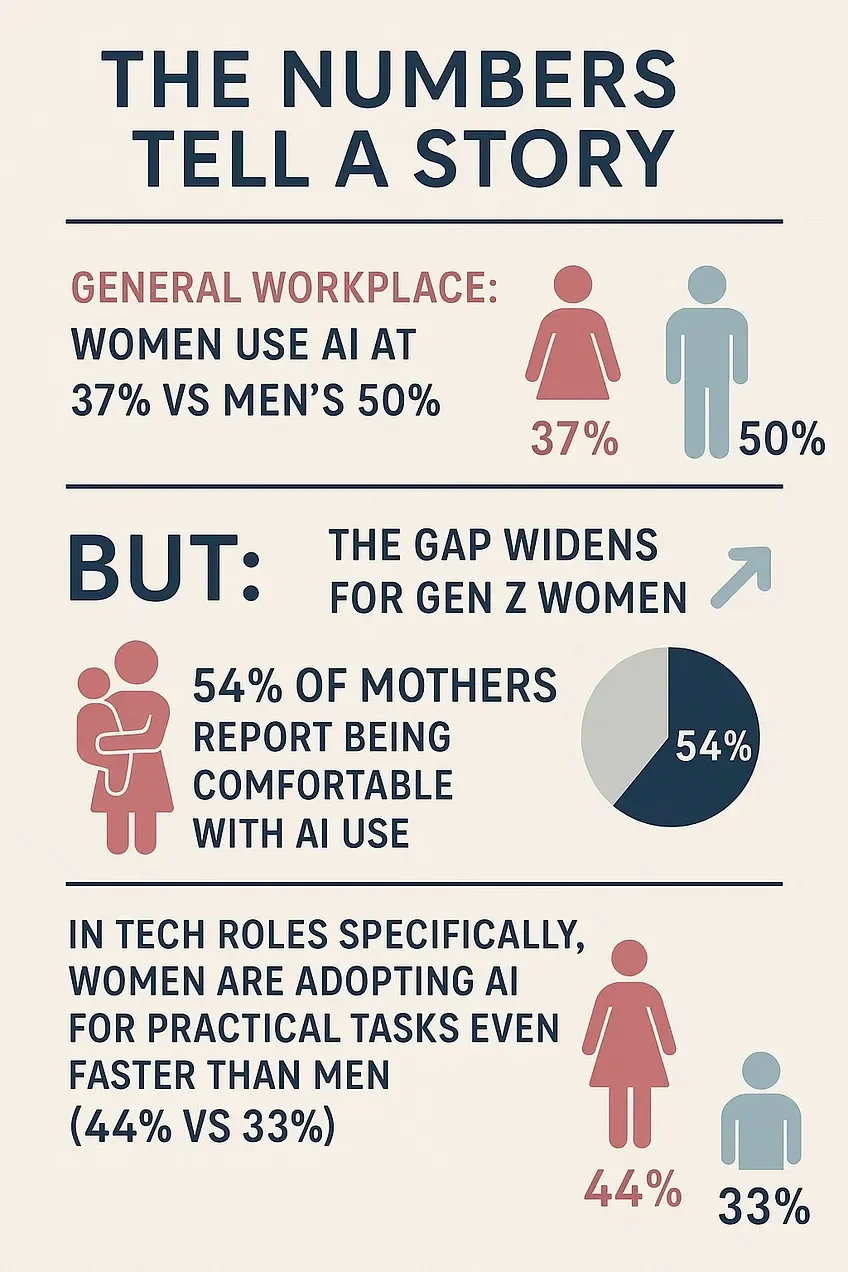
ChatGPT generated infographic based on statistics from my Perplexity query.
Why Care Perspectives Are Essential for Ethical AI
I’m an organizational and change management nerd, but I’m also an academic with a background in human learning and development, as well as a student of scholars steeped in understanding identity, morality, human motivation, power, relationships, and how systems shape people (and vice versa). Time and again, I’ve seen that the most sustainable, human-centered innovations often come from those who understand systems at their most complex and personal level (like Jacinda Adern, for example).
Ultimately, what I am yearning for is an ethic of care in the development of AI. And I think it’s the moms who have the key. Arising out of feminist psychology work in the 1980s, an ethic of care describes a relational approach to morality (versus the dominant justice based approaches) — one that emphasizes relationships, context, vulnerability, and interdependence over abstract principles or some sort of ‘impartial’ reality.
When we look at AI through a lens of ethics of care, we ask questions like: How might AI-augmented decision making result in less ethical decisions due to moral distancing? How might different users, with different goals and problems to solve, necessitate different kinds of models built on different kinds of data? Or, how do we frame AI as its own kind of intelligence, and therefore how do we relate to it? And what might that mean for human relationships? Or even how, by nature of the way these models are designed to recognize complex patterns, they might increase our ability to understand and highlight the “particulars” over the “generals” in our thinking, thus potentially “setting the stage for a broad and deep change that puts caring relationships at the heart of our moral thinking.” 🤯 These are the really juicy questions! We need to answer them, but we also need to have folks in the room who will ask these questions to begin with.
For example, a recent podcast I was listening to (I listen to a lot and can’t remember which specific one) had a guy from tech talking about how ‘easy’ it would be to deliver educational content to students through personalized tutors and thus revolutionize teaching. Sure, that might be possible, but at what cost? Are teachers merely content deliverers? Anyone who knows anything about education, the classroom, youth development, and school systems knows that the heart of teaching is the student-teacher relationship and that it is that relationship that enables not only knowledge transfer but scaffolded learning. Moreover, schools are more than just knowledge banks; they are critical deliverers of social services, social labs where our kids develop, and builders of diverse communities. My hunch is that this is the kind of thing that moms think about… a lot. And these are care-based, relationship-based, systems-based questions which, when considered fully and authentically, would probably lead to completely different design and implementation decisions or, at minimum, a bit more awareness about the impact such “solutions” might have down the line (looking at you…Meta/Instagram).
Mothers are Systems Orchestrators
It’s easy to dismiss the work of household management as simply multi-tasking. And many apps marketed toward women do just that, by offering to be a digital second brain or calendar to end all calendars or the app that will help your partner finally remember what to get at the grocery store (cringe).
But caregiving involves understanding how dozens of interconnected systems influence each other, the consequences of various choices, and the impacts decisions will have on the entire family system. And that’s even the relatively straightforward households. If you’re managing multiple generations, medically complex situations, or living paycheck to paycheck, it simply compounds the complexity. Everything creates ripple effects.
It’s this natural systems awareness and ability to think in systems and the relationships in these systems that we need more of in AI development. This perspective can both point the way toward the complex, wicked problems most in need of attention (hi, nonprofits and philanthropy) and how to go about addressing them effectively. Systems orchestrators understand that one-size-fits-all approaches rarely, if ever, work, and that networked action and interventions that build capabilities within the systems versus extract from them are the only sustainable avenues for change.
One of the things that excites me most, as I shared during a recent State of AI panel with the Center for Digital Strategy, is the real opportunity for collaboration enabled by AI. Teams and organizations that are able to leverage AI tools across systems versus in silos could realize exponential impact because the ripples become things we can document, interrogate, understand, and replicate. But so many organizations are rolling out siloed AI upskilling and implementation plans or investing in an AI solution based on the needs of one department, or assuming AI might fix what are actually org culture and people challenges. When we think about systems, relationships, and care, these are the issues we’ll see.
Relationships Are Front and Center
Those focused on care work are also more likely to approach AI with some very critical questions in mind: how will this affect my relationships? What does using this tool mean for my human values, and my value as a human? How does using this tool replace human connection? What are the long-term implications of these tools? How might these tools impact those in my system, under my care, or in my organization?
These questions all focused on the in-between relationships of our lives. What’s between AI and I — how am I being influenced by it, and how am I shaping it? What’s between you and I — how does AI help us connect, how does it get in the way? What’s between AI and us — how does (or how might) this technology shape what’s possible for our homes, organizations, schools,and communities?
I want these questions at the center of AI development, not as an afterthought.
The Cost of Care-lessness
When we develop AI without these relational, interdependent, systemic perspectives, we get tools that optimize efficiency over building relationships, models that miss critical context about humanity and our diversity, technology that is highly disruptive of our day-to-day lives instead of supportive and, ultimately, AI that perpetuates existing inequities instead of helping us to challenge, reshape and, ideally, upend them.
Brilliant people with far more expertise than me are doing this work and sounding this alarm, and they have been for years. But, as usual, the dominant narrative that “women are lagging behind” is deficit-based, oversimplified, self-perpetuating, and completely misses the point. And while targeted upskilling may help address the gap, I want us to look at the system around the gap and what it might be telling us. Not because we want to make sure women are using AI as much as men in service of business ROI, but because we truly believe that women engaged with AI will make AI solutions and implementations better and because we truly believe that women’s economic outcomes and care-giving, ethics-focused work actually matters in this world. I want us to be fired up about the gap because we realize that when women, and especially mothers, are less engaged with technology as transformative and relational as this, it’s all of us who will suffer (at least those of us in the 99%).
So, each time you find yourself talking about the gender gap in tech or the nonprofit gap in tech, I want you to challenge the discourse to go deeper and shout from the rooftops why this is so important to address.
At the same time, my suggestion to focus on valuing, amplifying, and uplifting women, mothers, caretakers, and how that could inform an overall ethic of care is not to suggest that responsibility for implementing care-based perspectives rest solely on their shoulders. As thinkers in the AI + feminist space have pointed out, the goal is a shared culture of ethic of care practices within entire organizations, across all levels of hierarchy and identity. That means men and non-parents/caregivers showing up as allies and understanding that they have an active role to play.
Finally, but no less concerning, the biases inherent in the dominant AI models present yet another critically important reason that those focused on interdependence, systems and ethics of care, and relationships across power need to be at (or at the head of ) the table. Because of the disproportionate risk AI presents to already marginalized groups, only intentional incorporation of care-based perspectives — not just handwaving and a slew of ‘technical fixes’ — will stand a chance against not only perpetuating these biases but deepening them further.
Moms Get S&*# Done
I realize that in this post, I went from complicating the gender gap in AI adoption to motherhood and an ethics of care, to the role that nonprofits/philanthropy and mission-driven organizations and leaders can play in shaping AI toward the greater good. It’s a little squirrel/neuro-sparkly, but it’s a pattern that’s been taking up a lot of rent in my brain lately. To me, all of these things are connected because they encourage us to look beyond the revenue-driven goals of scale, users, and market niches to the soup-to-nuts processes that exist throughout all stages of tech tools, innovation, design, development, implementation, and impact.

Image from Dr. Kristin Neff’s Fierce Self-Compassion work.
As I sat reading through this post for final tweaks, I looked over and saw a picture I had saved from Kristin Neff’s Fierce Self-Compassion work, a book I read when coming back from my second maternity leave. Neff defines the idea of fierce self-compassion as being about holding both the tender (caregiving) work and the fierce (protective) work in tandem with one another in a way that creates a “caring force” that can allow women to thrive. It occured to me that that’s another way I see the need for a more feminine/maternal force in AI that goes beyond women as just users of platforms: I want to see the fierce advocacy for human dignity as well as the tender attention to relational nuance.
From Knowing to Learning and Doing
I don’t just want more period/fertility/calendaring/meal-planning apps. I want the humans that make up the entire system of creating, designing, and deploying AI to build their muscle of asking: Who might this solution/product harm? Who does it help? What are the implications beyond the immediate applications of this system/product? How does this idea actually improve daily life? How does this protect human dignity and connection?
And I want them building that muscle because they know it’s hard to ask those questions, that it’s a habit they need to build, and that they need to do it because if not, we’re likely to leverage this tech in ways that will truly disrupt the fabric of our societies, families, and relationships.
As Baratunde Thurston wrote recently, we saw what can go incredibly wrong with tech through social media and the damage it is doing to our ability to connect and to young people’s mental health. There’s a reason that Jonathan Haidt’s book, Anxious Generation, is so popular in my local moms’ groups, and we’re banding together to purchase land lines for our houses and aligning to avoid phones until 8th grade. We, and especially moms, learned so much. But knowing is not the same as learning. In leadership and behavior change, we consider that you’ve really only learned from something if you’re able to apply it and change your behavior as a result.
Right now, part of what feels so scary about AI is that it’s looking like we haven’t learned. Or worse, that we know exactly where this train could go, we just don’t care.
Your Micro-Moves This week
Ok, so I convinced you? We need moms (i.e. caretakers) and their perspective at the forefront of our discourse around AI. So, what’s one person in this weird and wonky system to do? Here are some ideas:
The next time someone mentions the gender gap in AI (or any other demographic or identity-based gap for that matter): focus on the consequences, the surrounding systems, and the remedies. Instead of commenting or joining in about why this is a problem with women, ask the more interesting questions: What wisdom are we losing when women aren’t involved? What reasons/concerns are leading to this gap that we should all be more mindful of? What changes in applications and models do women need to see in order to participate and engage?
Document your care wisdom and seek out the care wisdom of others: Think about the ways you care for others, the insights it offers you, and make space for others to share the same. In a polarized society where the algorithms are pushing us toward black/white thinking, it can be really challenging to see interconnectedness. But, when we focus on how we care for others, whether we’re a parent or not, we naturally start to see relationships, interconnections, and dependencies within our day-to-day lives. Ideally, we’re bringing that lens of interconnectedness into our leadership and everything we do, but a first step is simply tuning into it and see the ways that care functions in our systems and organizations.
Question the metrics: When AI tools or initiatives promise ‘productivity’ be sure to ask “for whom?” and “at what relational cost”?
If you’re leading or involved with AI implementation at your organization, pay attention to the gaps in usage at your organization and find out what’s contributing to it. Even better, make sure that you have parent perspectives on your AI steering/strategy committee.
Diversify your feed. Start following women in AI. Check out She Leads AI. Purposefully seek out those who are questioning and critiquing AI who represent marginalized identities and voices in tech. Read their commentary with an open, curious mindset.
I’d love to hear your thoughts on this post. What resonated? What are you curious about? Do you see things differently?
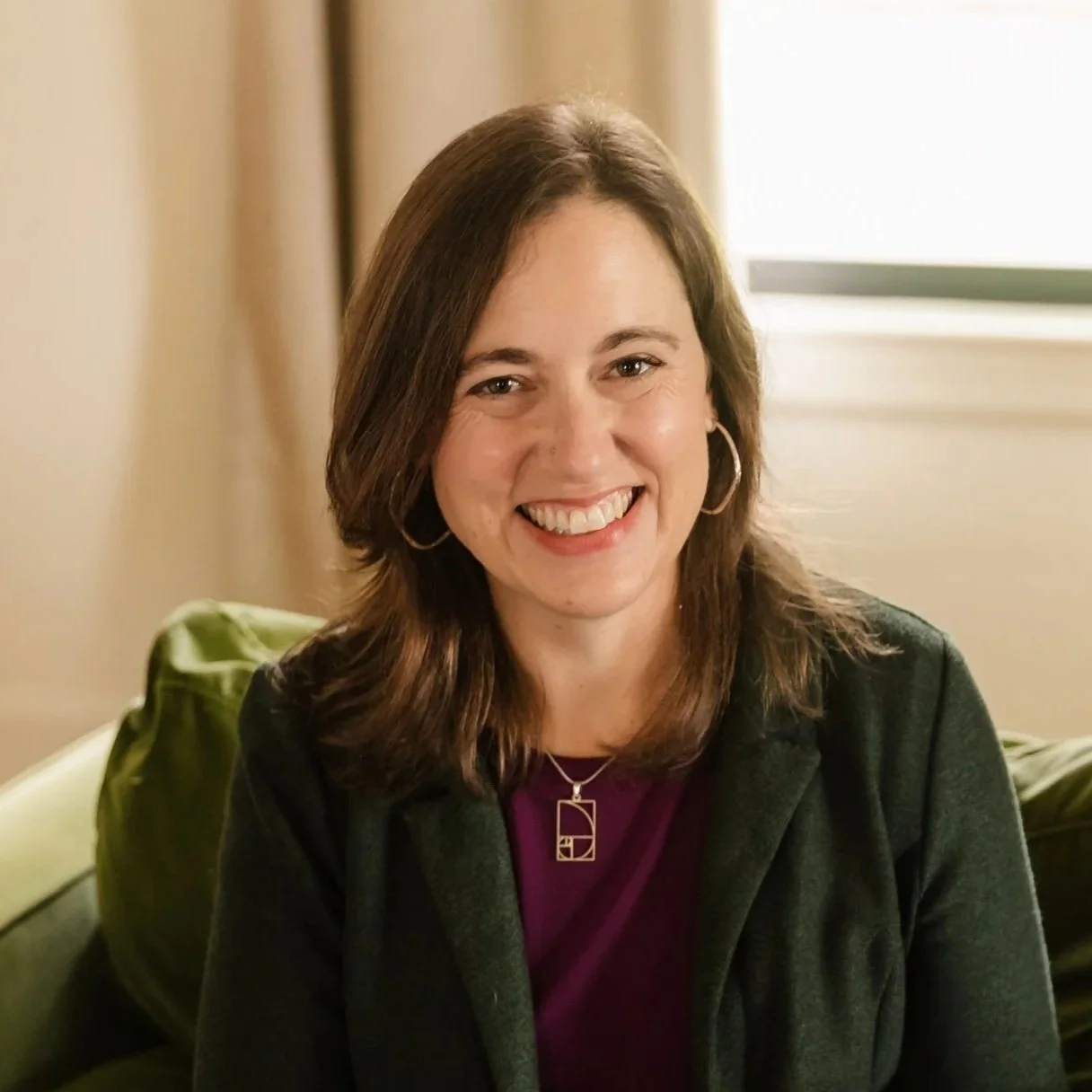
Valerie Ehrlich, PhD, is the principal of Mission Bloom, where she helps mission-driven leaders use AI responsibly, smartly, and powerfully. She specializes in helping organizations in the social sector navigate AI implementation from a values-centered perspective.